What is an Atoll?
An atoll is the final stage of volcanic island erosion. Coral reefs grow near sea level around the edges of ancient volcanoes. When volcanoes begin to sink, the coral reefs continue to grow upward. The volcanic peaks continue to sink and erode, until they are below sea level, leaving islets that have built up on the reef.
The strongest winds in the Marshall Islands generally blow from the northeast. Marshall Islanders say they have two seasons:
1. Añōneañ - When the sun rises and sets toward the south, and the wind is strong and comes from the northeast.
2. Rak - When the sun rises and sets toward the north, and winds lighten and come from the south.
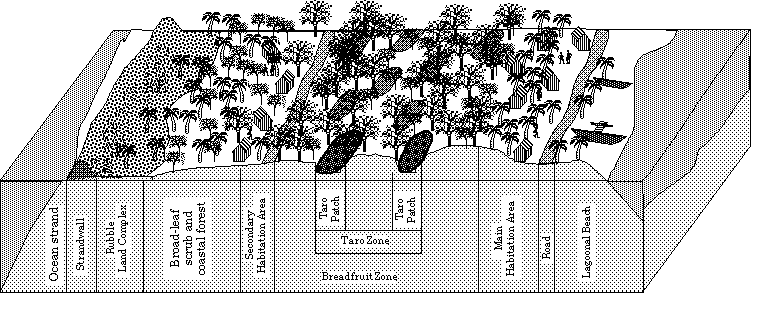
More favorable agricultural conditions exist on the leeward (western) islets of the atolls, which are better protected from salt spray and waves. Unfortunately most of the large land areas are located on the windward (eastern) islets of the atolls (as illustrated above).
Vegetation Types
Plants whose ancestors arrived in the Marshall Islands without human help are called native or indigenous plants. This happened when seeds and spores arrived by wind, or on migrating birds, ocean currents, or floating plant material. Native plants and animals found in only one particular place or region are known as endemic. Plants brought into the Marshall Islands by people (on purpose or by accident) are referred to as alien or introduced. Most of these plants were brought to provide food, fiber (for clothing, housing, canoe building, etc.), and medicine. The Marshall Islands was one of the few areas in the world where no traditional psychoactive substances were consumed before recent times, either because the necessary plants were not present or because the process of obtaining an intoxicating drink from a plant was not part of their cultural practice. Scientists who study the traditional knowledge and use of plants in different societies are known as ethnobotanists. In addition to food, clothing, shelter, transportation, and medicine, plants have provided a great many other things that people now either buy in stores, or do without.Vegetation, or plant communities, are made up of individual plants of specific types (species) that are adapted to live together in particular kinds of environments. The plant life forms of the Marshall Islands can be grouped into five types of vegetation. These plant communities are shown below.
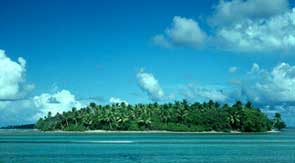 Mar-in-ioon-kappe: (Coastal Vegetation) Plants located along sandy and rocky shores. |
|
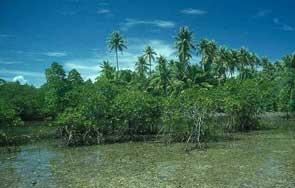 Pat: (Mangrove or Wetland Vegetation) Vegetation found along coastlines and inland depressions with salty or brackish water. |
 Buļōn-mar: (Atoll or Interior Forest) Native trees, shrubs, and herbs in uncultivated or abandoned areas. |
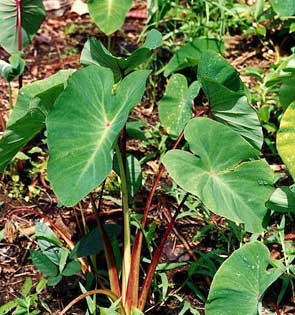 Kein-ikkan: Cultivated Vegetation Cultivated lands, including agroforests of tree crops and other associated cultivated species, and natural or excavated swampy depressions where certain "root crops" and associated weeds grow. |
|
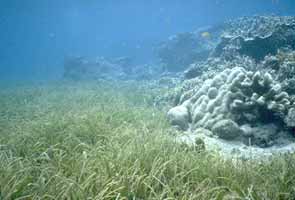
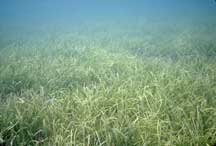
Wūjooj-in-lojet: (Saltwater Aquatic Vegetation)
Sea grass communities.Marine wetland vegetation is relatively rare in the Marshall Islands. It occurs in a few areas that are continuously flooded by saltwater. Typically, this type of vegetation (wūjooj-in-lojet) refers to all sea plants, including sea grasses and algae, which are restricted to these marine environments. These plants are referred to as sea grasses. Beds of sea grass are located in shallow water up to about 7-8 meters (20-25 ft) deep. Below this depth there is not enough sunlight for sea grasses to survive. Many species of marine algae are also found in sea grass areas.
Table 1. Keystone species of the sea grass community. Wūjooj-in-lojet Thalassia hemprichii Hydrocharitaceae The saltwater vegetation forms a very productive ecosystem, but it can be damaged severely if much disturbance takes place in nearby areas. For example, on the islands of Pohnpei and Kosrae, excessive soil runoff due to increased erosion on land may limit the sunlight available to the algae and sea grasses, stunting their growth, or even killing the plants. Reduced algae and sea grass growth may in turn limit the growth and development of marine animals dependent upon these plant organisms.
Where sea grass beds do occur they provide food and shelter for a number of animal species, including turtles. The two different species of marine turtles found in the Marshall Islands are jebake, the critically endangered hawksbill sea turtle (Erytmochelys imbricata), and wōn, the endangered green sea turtle (Chelonia mydas). It is said that turtles were more abundant in years past because the equipment used to catch the turtles was less efficient than the modern gear fisherman use today. Turtles are now caught and sold to markets in Ebeye and Mājro for special occasions. Hopefully this has at least become less common. They are also hunted at important nesting areas on sparsely inhabited or uninhabited northern atolls now that larger, faster boats are readily available.
Mar-in-ioon-kappe: (Coastal Vegetation): Plants located along sandy and rocky shores.Coastal, or near shore, vegetation is found in a narrow zone (strand), near the ocean (or in some places close to the lagoon edge) on open sandy and rocky shores. Because the atolls and reef islands of the Marshall Islands have extensive sandy and rocky shores, this type of vegetation is common. Several plants found in this plant community are used traditionally for various purposes, including use as a windbreak and to control erosion.
Although plants of different forms, such as trees, shrubs, vines, and herbs, are all found in the coastal vegetation of the Marshall Islands, they share several things in common. For example, many produce seeds that float and are able to survive in saltwater for long periods of time. These seeds can be carried long distances by ocean currents. The strand plants also have to be able to survive in very sunny, often windy, salty conditions near the seashore. Many coastal plants are non-woody (herbs) with fleshy leaves and salty sap.Coastal vegetation growing near the ocean on open, sandy (ioon bok) and rocky (ijoko redekāke) shores is referred to by scientists as the littoral vegetation (litoralis = shore in Latin). The plants that are found in the coastal vegetation can be divided into several distinctive types of littoral plant communities. These include the following:
1. Herbaceous Strand or non-woody vegetation located above the high tide mark on both sandy and rocky shores. Extensive areas are found along beaches of sand and coral rubble. Typical herbs in the strand include atat (Triumfetta procumbens) and markinenjojo (Vigna marina).
2. Littoral Shrub land located on the seaward edges of coastal forests. The usual dominant plants of this community are kōņņat (Scaevola sericea) and kiden (Tournefortia argentea).
3. Pandanus (Edwaan) Scrub located on some rocky, often exposed, windswept shores. As indicated in its name, this community is dominated by Pandanus tectorius plants, also known as "screwpines" because of the strange, twisted growth of the terminal leaf clusters.
4. Littoral Forest is the most common kind of vegetation found along tropical shores, including the Marshall Islands. It is usually dense and is sometimes dominated by a single tree species. Common trees in this community include kōņo (Cordia subcordata), utilomar (Guettarda speciosa), wōp (Barringtonia asiatica), lukwej or jijo (Calophyllum inophyllum), and piñpiñ (Hernandia sonora).
Table 2. Keystone species of the coastal area. (Complete species checklist) Marshallese Names Scientific Name Family Atat Triumfetta procumbens Malvaceae Bōb Pandanus tectoriu Pandanaceae Dāpijdekā Boerhavia sp. Nyctaginaceae Kālōklōk Caesalpinia bonduc Fabaceae Kaar Premna serratifolia Verbenaceae
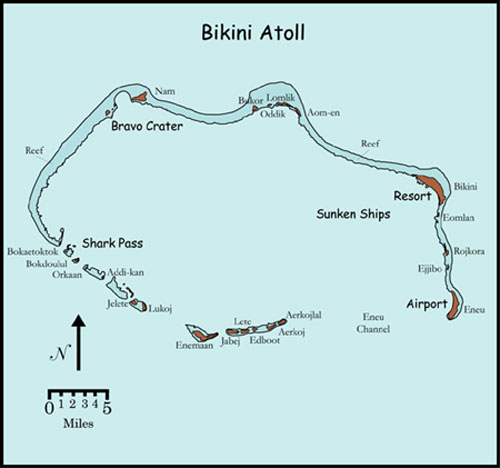
Pat: (Mangrove or Wetland Vegetation): Along coastlines and inland depressions with salty or brackish water.Mangrove forests are composed of woody plants (trees and shrubs) adapted to areas with tidal inundation. These distinctive forest communities are located in many subtropical and tropical areas around the world, including a few atolls in the southern Marshall Islands. In the Marshall Islands, mangrove vegetation is not common, but it does occur naturally in saltwater-influenced swamps. It is also found in some inland depressions, where it is probably the result of human introduction, especially the purposeful planting of joñ (Bruguiera gymnorrhiza) in inland depressions known as pat. Naturally formed but poorly developed, small stands of mangrove trees are found on Aelōñļapļap, Arņo, Jālooj, and Mājeej. Some mangroves also grow on Mājro and Pikinni, but they probably are the result of seeds planted by humans.
In 1953, the botanist Hatheway described the mangrove vegetation on Arno. In most cases, mangrove plants were found in shallow embankments or tidal flats that opened on to the lagoon. However, in one case an embankment had been closed off by drifting sand. Here the mangrove forest formed only a ring of trees bordering a shallow depression that became flooded with salt water at high tide. Hatheway described this kind of mangrove stand:
"Scattered, mostly prostrate [low lying] trees of Sonneratia [būļabōļ]...bordered the central flats of sand or mud: their erect, conical pneumatophores [breathing roots] extended 20 feet or more beyond the main boles of the trees toward the center of the embaynkment. Behind the Sonneratia trees and tending to fill the gaps between them occurred the more erect Bruguiera [joñ], perched upon which were aerial baskets of Nephrolepis [anmōkadede] and Asplenium [kartōp]...Forming a zone around the [joñ] were thickets of Pemphis acidula [kōñe], the sprawling main trunks of which sent up erect branches 15 to 20 feet in height and over 6 inches in diameter."
Although mangrove forests are relatively rare in the Marshall Islands, the plants of these forests, especially those of the larger islands of the tropical Pacific, are important natural components of the environment, or ecosystem. For example, on the higher islands of Micronesia, such as Pohnpei and Kosrae, mangrove trees help stabilize coastal areas by trapping and holding sediment washed down or out from inland areas. In some areas, the mass of tangled roots of the woody mangroves prevent much of this mud from washing out and smothering the coral reefs. Mangrove forests growing along the seashore also offer some coastal protection from normal wave action and strong storm surges.
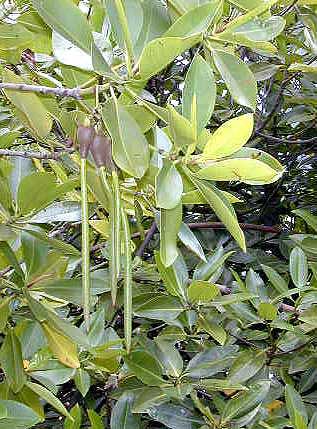
Figure 5. Fruits of Eoeak (red mangrove). As "producers," the mangrove plants convert energy from the sun into useful carbohydrates and proteins through the process of photosynthesis. These substances are then stored in the leaves or other parts of the plant. Eventually these plant parts drop off into the water and decompose. These materials are then carried out with the tides to the near shore waters as a rich "nutrient soup." This soup serves as an important source of food for reef animals, and for the animals living within the mangrove swamps. These swamps also serve as nurseries for many kinds (species) of young shellfish, finfish and birds.
Mangrove trees must have a special means of obtaining oxygen because their roots become submerged in water when the tide comes in. This blocks the usual route of oxygen absorption -- through the roots. Some woody mangrove plants have roots above the ground, for example eoeak or būļabōļ (Rhizophora mucronata). These aerial prop roots have air canals that allow the trees and shrubs to absorb oxygen. Eoeak or būļabōļ (Rhizophora mucronata) can be identified quite easily by their aerial prop roots. Other mangroves, such as būļabōļ (Sonneratia alba) and kimeme (Lumnitzera littorea) can be recognized by exposed, cone- or pencil- shaped roots (pneumatophores) that stick up through the muddy soil from extensive, cable-like rootstock. Joñ (Bruguiera gymnorrhiza), which is shown color plate #4, represented in the diagram below, has spreading, knobby (or "bent-knee") breathing roots.
A number of plant species can be found growing in the mangrove forests of the Marshall Islands. Together, as noted earlier, these specially adapted plants form a vegetation zone in some of the Marshall Islands, in depression areas behind the coastal strand of sand or coral rubble. The most common woody plants in the mangrove forests are listed below. Notice that there is a Marshallese name and scientific name for each species, but these four different species are all referred to by the same name in English because the English name is less specific and includes all types of mangrove. However, in some English speaking areas, mangrove species are separated according to their color; for example, red mangrove, white mangrove, black mangrove, and others.
Marshallese Name English Name Scientific Name Family Būļabōļ or kōnpat white mangrove Sonneratia alba Sonneratiaceae Eoeak red mangrove Rhizophora mucronata Rhizophoraceae Joñ black mangrove Bruguiera gymnorrhiza Rhizophoraceae Kimeme mangrove Lumnitzera littorea Combretaceae The mangrove vegetation can be divided into different zones from the edge of land out into the lagoon, or from the shore out onto the muddy reef flat. First, there is the intertidal border zone where the coastal forest and mangrove plants meet. It is a narrow zone along the high tide line with little or sometimes no vegetation. This zone usually has shallow mud deposits with patches of shrubs and trees. Some muddy areas in this zone emerge at low tide. This inner margin of the mangrove forest is usually quiet and protected. It is an important type of environment to collect atūñ, the mangrove crab (Scylla serrata). This valuable animal resource is a popular tropical Pacific Island food. Eoeak or būļabōļ (Rhizophora mucronata), a prop-rooted mangrove tree, is relatively common.
In many areas, the trees of the mangrove forests provide raw materials for several purposes, including building materials, wood fuel, craft wood, charcoal, resins, and bark products. Unfortunately, in many parts of the tropical world, mangrove forests are being destroyed by over-cutting, dredging for land reclamation projects, and by upslope forest clearing.
Notes on the plants of the mangrove forests are included in Chapter III where the plants are listed in alphabetical order according to their Marshallese names.
Bulōn-mar: (Atoll or Interior Forest): Native trees, shrubs, and herbs in uncultivated or abandoned areas.
In the humid tropics, mixed broadleaf forest is very common and conspicuous in areas undisturbed by human activity. On small tropical islands like the Marshalls, this type of forest has a low to medium height with a closed canopy (a forest in which there is little or no open space between the topmost layers of the leaves, twigs, and branches). The mixed broadleaf atoll forest of the Marshalls is usually composed of relatively few species of trees, shrubs, and herbs. Epiphytes (plants living on the surfaces of other plants) such as kartōp, the "bird's nest fern" (Asplenium nidus) are found in the wetter southern atolls, but there are only a few species of these so-called "air plants" in the atoll forests of most of the Marshall Islands.
Several of the woody and other plants in the atoll forests of the Marshall Islands are listed below. It should be noted that some of these plants are found only on the more humid islands of the southern Marshalls.
Table 4. Keystone species of the atoll forest. (Complete species checklist) Marshallese Names Scientific Name Family Anmōkadede or baidik Nephrolepsis acutifolia Polypodiaceae Armwe Pipturus argenteus Urticaceae Atat Triumfetta procumbens Malvaceae Baañke Cucurbita pepo Cucurbitaceae Baidik Nephrolepis biserrata Polypodiaceae Several of the herbaceous and woody plants found in the mixed, broadleaf atoll forests can also be found growing along the rocky shores. Because this low coral island forest often includes plants of the coastal or littoral vegetation, the border between the strand (or other forms of the littoral vegetation) and the inland forest is sometimes unclear or gradual.
Human activities have greatly changed the vegetation of atoll and reef island forests of the Marshall Islands over many generations of use. Numerous plants found in this type of vegetation are useful, serving as sources of food, fiber, and construction materials. On relatively undisturbed atolls, this type of forest is usually found in the interior of the larger, wetter islets. On the more disturbed islets, it is usually found behind the strand vegetation, along sandy or rocky coasts, especially as crescent shaped strips of forest on the windward sides where they have been left as windbreaks to protect coconut plantations and taro pits from salt spray. This cultural practice is quite advantageous -- it helps preserve biodiversity (the natural variety of species) and aids food and copra production in the harsh atoll environment.
Many plants in the atoll forest are useful. Some plants, like mā, the breadfruit tree, and makmōk, island arrowroot (a large under story herb), are valuable sources of food. Other plants, such as bōb and wūmaañ, are important as sources of fiber for weaving. Some plants, like nen, serve as sources of medicine. And, of course, there are plants, such as ni, nen, mā, and bōb, which have several different uses. For example, the fruit of bōb is a very important food source. When fresh it is eaten as fruit, when cooked it is eaten as starch. When preserved, bōb keeps for long periods of time, and usually served as food on long voyages or during the season where breadfruit and other food are not available. When preserved it is used as a staple food, as well as a form of nutritious drinks known as "Jennup."
Kein-ikkan: Cultivated Vegetation
The traditional cultivation of plants has been very important to tropical Pacific Islanders for many centuries, not only for the food produced, but also for many other resources. In fact, the farming of useful plants has taken up so much of the time of so many persons in the region that a great many social relationships have affected gardening procedures, or been shaped by them. Today the people living on the outer atolls of the Marshall Islands are more strongly associated with and dependent upon the plants they cultivate than people living on the urbanized atolls of Mājro and Kuwajleen.
Cultivated areas in the Marshall Islands are called jikin kallib - places reserved for planting. For many hundreds of years, the cultivation of useful herbs, shrubs, and trees has had a significant impact on the natural broadleaf forests in many areas of the Marshall Islands. Cutting, burning, planting, harvesting, and other activities have changed the natural ecosystems. Before people arrived in the Marshall Islands, dense forests of native plants probably covered much of the land area, especially in the wetter southern atolls. Most of these low island forests have been cut down. In the past, many plants and trees of the original forests were used to construct houses. And, of course, many houses - as well as other buildings, structures and roads - have displaced plant life in the Marshall Islands, especially in modern times. Areas that were once native forest are now used for growing breadfruit trees (mā) and coconuts palms (ni), as well as several other cultivated trees, taro plants (iaraj and kōtak), additional non-woody crops such as bananas (keeprañ, pinana) and papayas (keinabbu), and several ornamental flowering species.
Some islands are too small to support permanent occupation or agriculture, but members of the bwij ko (lineages) that own these lands may visit them from time to time to catch birds and to collect eggs and plant materials, including coconuts, pandanas, and breadfruit. Islands that are taboo (mo) may not be visited without the permission of the chief (irooj). These islands will also be untended and overgrown with native vegetation, but they will have food and other plants that may be gathered for the irooj. Some weedy species are also commonly found in cultivated areas.
Table 5. Traditional cultivated keystone species. (Complete species checklist) Marshallese Names Scientific Name Family Abļajtiiñ Gomphrena globosa Amaranthaceae Albokbūroro Russelia equisetiformis Scrophulariaceae Alōklōk Xanthosoma sagitifolium Araceae Anmōkadede Nephrolepsis acutifolia Polypodiaceae Baañke Cucurbita pepo Cucurbitaceae Traditional agroforestry farming system
An area with cultivated trees (and some wild plants) often forms an artificial forest with understories of shrubs and herbs, which scientists refer to as an "agroforest." This type of man-made forest, or traditional agroecosystem, combines native and alien species. Agroforestry has been defined technically as "any sustainable land-use system that maintains or increases total yields by combining food (annual) crops with tree (perennial) crops and/or livestock on the same unit of land, either alternately or at the same time, using management practices that suit the social and cultural characteristics of the local people and the economic and ecological conditions of the area."
Figure 1. A leeward (western) atoll islet profile, showing traditional land use patterns (Credit: D. Spennemann).
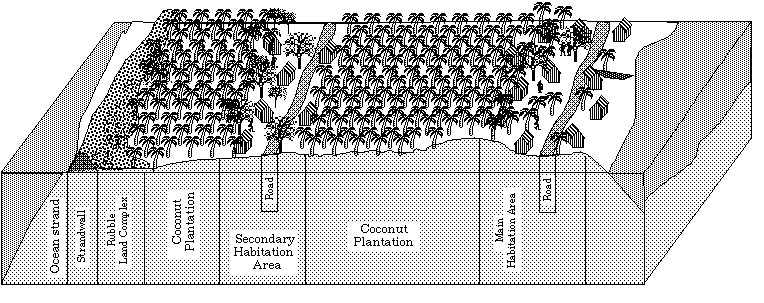
Figure 2. Typical modern vegetation zonation pattern of a leeward atoll island. Taro patches and breadfruit are no longer maintained. Instead, islanders have planted coconut palms, from which they produce copra. (Credit: D. Spennemann).Agroforestry is the major agricultural land use in the Marshall Islands today, as it has been for centuries. Nearly all production of crops is done by family units using local agroforestry technology. Commercial monocropping (cultivating a single crop) in copra (coconut) plantations was developed in historic times. Under the Japanese administration (1914-1915), the Marshall Islands produced the most copra in Micronesia. Today many groves are aging and not well maintained. Copra production has been steadily declining in recent decades.
Traditional agroforestry in the Marshall Islands is a complex, sustainable system of land use. It does not generally exhaust the soils, and thus continues to provide much food and other resources such as timber, fiber, and medicine for the people in areas where it is still practiced. Nevertheless, although the traditional cropping system of agroforestry has significant value in its provision of nutrition, cultural preservation, and rural economic stability, this long-lasting local farming system is changing. For example, there is evidence that use of taro pits (bōl) to cultivate plants such as iaraj (giant taro) is declining in some islands due to the importation of foreign foods such as rice and flour.
Before we discuss the problems associated with the current changes in and decline of traditional agroforestry, and the relationships of this decline to human population growth and commercial development, let us briefly review the historical development of agroforestry in the Marshall Islands and some key cultural factors involved.
When Micronesian settlers first arrived in the Marshall Islands from their ancestral homeland beginning perhaps more than 3,000-4,000 years ago, they found low-lying atolls and reef islands covered with native vegetation of strand, scrub, forest and, on some islands, mangroves. Plants brought in by these early settlers, especially breadfruit, coconut, taro, and pandanus, probably became major components in the agricultural system soon after their arrival. At the same time, early settlers in the Marshall Islands also learned to make use of the native plant species of their newfound home. Over a long period of time, numerous crop plants and agricultural techniques were introduced through continued waves of human migration and cultural exchange. Agroforestry in the Marshall Islands is the result of thousands of years of development and refinement.
In addition to the trees, shrubs, and herbs that are planted in the cultivated areas, there are also many woody and non-woody plants that grow wild (in other words, without human help) in cultivated areas. Some are cut down, while others are not removed from the cultivated areas because they are useful, providing a variety of resource materials. Several plants, usually non-native species, are commonly found in disturbed areas such as ditches, rubbish piles, and roadsides. The vegetation in these disturbed areas is called "ruderal." It contains mostly "weedy" plants that are common throughout the tropical Pacific region. Weedy plants may be defined as plants found in areas where they are not wanted.
Although no record remains of the original Marshall Islands vegetation, we know that people have been in this region for thousands of years. These people, the ancestors of the present Marshallese, unquestionably altered the biota (plants and animals) and changed some environmental conditions; but they reached a balance or ecological equilibrium with their low coral island environments, and most of the original species and vegetation types probably survived. As we noted, change has been much more dramatic in modern times, including the period during which German, Japanese, and American colonial governments were in control.